Hottakes to Feed Your Craving

Our collection of free resources for you are the sweet syrup on top — free research-backed guides and videos for debt management, college survival, and career building.

🧙
How to Actually Survive a College Degree

The research-backed planning method, tools, and weekly habit — backed by real studies on grades, debt, and dropout risk. 8 pages, no email required.

✓ Instant download Research-backed 8 pages Free PDF

Why this matters

The numbers nobody hands you with your acceptance letter:

30%Grads working in their field
$33KAvg. debt at graduation
3xADHD dropout rate

Only 30% of 2025 graduates got a full-time job related to their degree — 26% ended up in an unrelated field, and 33% were still job hunting after graduation.

Source: Next Gen Personal Finance, "Question of the Day," 2026

Average debt at graduation runs $30,000–$36,000, with most borrowers taking 10–25 years to pay it off.

Source: Education Data Initiative, Average Student Loan Debt Report

1 in 6 college students report having ADHD — and those students drop out by year two at roughly 3x the rate of their peers.

Sources: Verdant Psychology (2025); peer-reviewed retention study, Journal of Postsecondary Education and Disability

The common thread in all three problems isn't intelligence or effort. It's the absence of a system for organizing a degree's worth of deadlines, readings, and deliverables. The good news: that part is fixable, and it's been studied.

Quick check: is your current system already failing you?

  • You've missed (or nearly missed) a deadline because it was buried in a syllabus PDF you forgot to re-check
  • You couldn't say right now, off the top of your head, what's due in the next 7 days across all your classes
  • You study by re-reading notes instead of testing yourself with quizzes or flashcards
  • You've pulled an all-nighter because a deadline "snuck up" on you
  • You have more than one class where you genuinely don't know your current grade standing

Checked 2 or more? That's not a willpower problem — it's a missing-system problem. Keep reading.

The 3 skills, plainly defined

The research keeps citing "OTMP skills." Here's what that actually means in practice.

  1. Organization. Keeping every deadline, reading, and deliverable from every class in one place you actually check — not scattered across syllabi, emails, and memory.
  2. Time management. Deciding in advance when you'll do the work, not just what the work is. A due date on a calendar isn't a plan — a scheduled study block is.
  3. Planning. Breaking big, vague tasks ("study for midterm") into specific, schedulable steps ("review weeks 1–4 flashcards Tuesday, practice quiz Wednesday").

Syllabus audit checklist — do this in week 1 of every class

  • Every exam and paper due date is logged in one central calendar
  • Weekly reading/topic load is mapped out, not just exam dates
  • Grading breakdown is noted, so you know what % each assignment is actually worth
  • Office hours and TA contact info are saved somewhere findable
  • You've identified the 2–3 heaviest weeks of the semester in advance

The proof it actually works

This isn't a productivity fad — it's backed by published research.

55–60% higher graduation rates for at-risk student groups who received structured academic support — including time management and planning help — over a 5-year institutional study.

Source: "Enhancing college student retention and graduation rates," Cogent Education (Taylor & Francis)

Significant improvement in attention, impulsivity, and academic impairment for college students with ADHD who completed a structured planning-skills training program — no medication involved.

Source: LaCount et al., Journal of Attention Disorders, 2018

Reduced anxiety, higher achievement linked to proactive time allocation and structured task completion among first-year college students.

Source: Design-based research study on first-year time management, published via NCBI/PMC

The pattern across every study is the same: structure beats willpower. The students who improved weren't smarter or more disciplined — they were given an actual method.

The system, step by step

  1. The planning method. At the start of every term, break every syllabus into three layers: deadlines, weekly topics, and study blocks. Most students only track layer one — the research shows the dropout gap closes when students track all three.
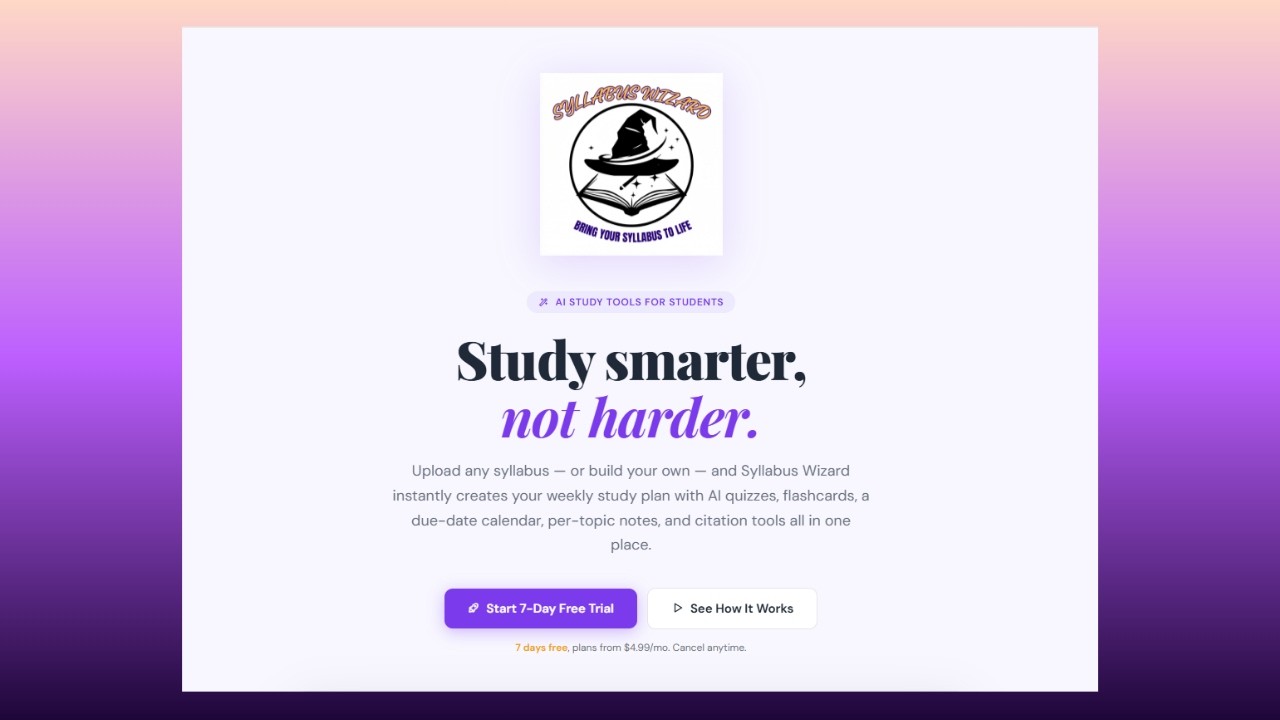
  2. The specific tools. You need one central calendar holding every deadline, a way to turn dense reading into quiz-able chunks, and a weekly "what's due" view you check the same day, same time, every week. This is the exact gap Syllabus Wizard was built to close.
  3. The weekly review habit. Pick one day (Sunday works for most students) and spend 15 minutes reviewing what's due in the next 7 days across every class — the single habit behind the 55–60% graduation rate improvement.

The 7-day system setup challenge

Do one of these each day. By day 7, your whole semester is mapped — or skip days 1–6 and upload your syllabus to Syllabus Wizard to do it automatically.

  1. Gather every syllabus. PDF, Word doc, or the professor's webpage — get them all in one folder.
  2. Log every major deadline. Exams, papers, projects, in one central calendar, not five different apps.
  3. Map weekly topics. What's actually being covered each week, not just exam dates.
  4. Identify your 2–3 heaviest weeks. The weeks where multiple classes collide — flag them now, before they surprise you.
  5. Set your weekly review day/time. Same day, same time, every week — put it on your calendar like a class.
  6. Build your first study blocks. Turn this week's readings into flashcards or a practice quiz — testing beats re-reading.
  7. Do your first weekly review. 15 minutes: what's due in the next 7 days, across every class? Now you know.

Try Syllabus Wizard free for 7 days →

💰
How to Increase Your Assets & Reduce Your Debt in 2026

Your complete action plan for getting ahead financially — 7 pages, no fluff, no email required.

✓ Instant download No email required 7 pages Free PDF

Why 2026 is your year to act

Most people spend their entire lives in a cycle of debt and financial stress — not because they lack ambition, but because they lack a plan. This guide gives you that plan: simple, actionable, and designed to work whether you're starting from zero or already on your way.

$59,580Avg. American household debt
77%Of Americans live paycheck to paycheck
2026Your year to change everything

The 5 assets to build in 2026

Building assets and paying off debt aren't opposites — they work together. Every dollar you free up from debt payments can immediately go toward building wealth.

  1. Emergency fund. Your financial foundation — without it, any unexpected expense goes straight onto a credit card. Target 3–6 months of expenses in a high-yield savings account, starting with a $1,000 first milestone.
  2. Retirement contributions. If your employer matches 401(k) contributions and you're not taking the full match, you're leaving free money on the table — an instant 50–100% return.
  3. Skills & education. Your earning power is your most valuable asset. A course or certification that raises your income by even $5,000/year compounds for decades.
  4. Investment account. Once high-interest debt is paid off, an index fund account builds wealth on autopilot. The S&P 500 has averaged roughly 10% annually over the past century.
  5. Real estate equity. Every extra mortgage payment builds equity that works for you — one extra payment a year can save tens of thousands in interest over a 30-year mortgage.

The fastest ways to eliminate your debt

There are two proven debt payoff strategies, and research shows both work. The key is picking the one that matches how you're wired.

The Snowball Method

List every debt from smallest balance to largest. Pay minimums on everything, then put every extra dollar toward the smallest debt first. When it's gone, roll that payment into the next smallest. Research shows snowball users are more likely to pay off all their debt because quick wins keep motivation high — this is the method Dave Ramsey built an empire on. Best for people who need momentum.

The Avalanche Method

List every debt from highest interest rate to lowest. Put every extra dollar toward the highest-rate debt first. This method saves the most money mathematically — on a $20,000 debt load, the difference can be thousands of dollars and years off your timeline. Best for people motivated by maximum savings who can be patient with a longer first payoff.

Real money-saving scenarios

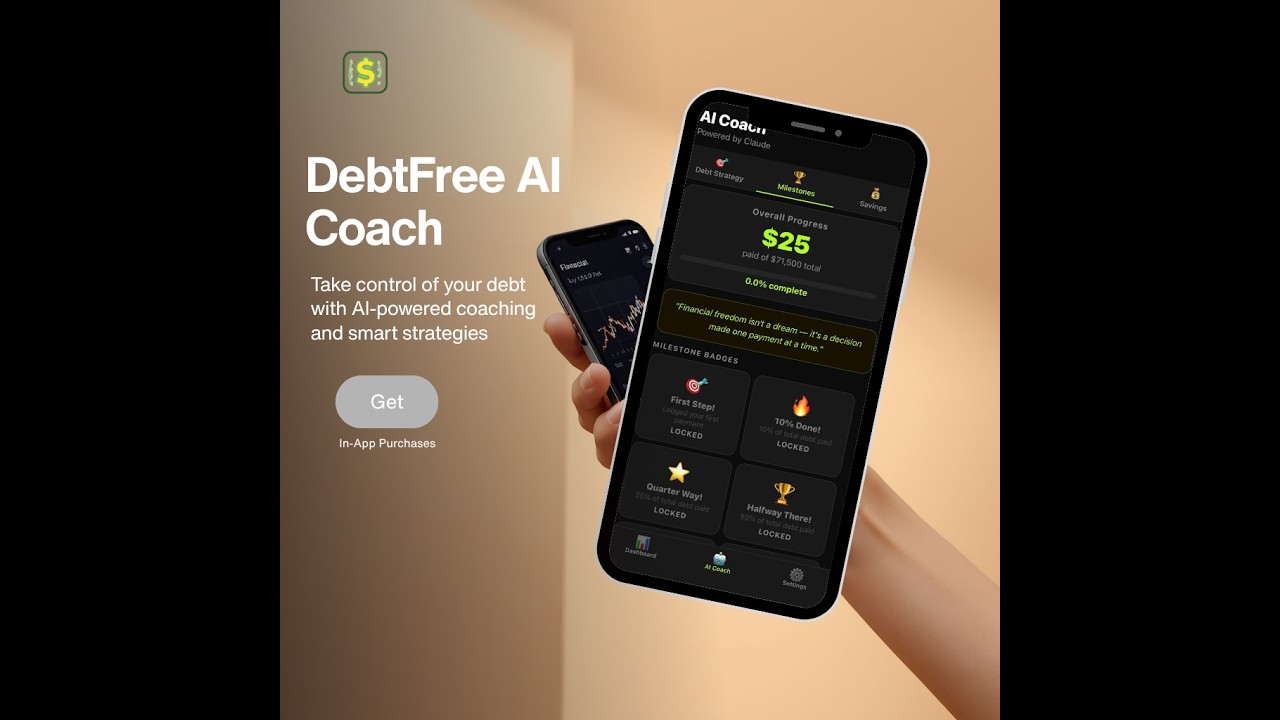
Numbers make it real. Here's how a smart payoff plan plays out — the kind of plan DebtFree AI Coach builds for you in 60 seconds.

  1. Sarah — Snowball saves $3,200. Four debts totaling $14,300, with $200/month extra available. Snowball method: debt-free in 26 months instead of 41 — saving $3,200 in interest and 15 months.
  2. Marcus — Avalanche saves $4,700. Two credit cards at 24% and 21% APR, with $300/month extra. Avalanche method: debt-free in 28 months instead of 52 — saving $4,700 in interest and 18 months.
  3. Jennifer — small extra payment, big impact. $12,000 in student loans plus a $3,800 credit card, with only $75/month extra. Targeting the credit card first: debt-free in 38 months total, saving $2,100 in interest.

The common thread: a plan. Knowing which debt to attack first, how much to put toward it, and seeing the exact payoff date keeps you on track. DebtFree AI Coach does all of this automatically — free.

Your personal debt payoff worksheet

Fill this in right now. Seeing your complete debt picture in one place is the single most powerful first step.

Debt / AccountBalance OwedInterest Rate (APR)


Want the full fillable worksheet plus your monthly numbers and goal-setting section? Download the complete PDF above.

Let DebtFree AI Coach automate your plan

You now have the knowledge. Here's the free tool that puts it into action automatically.

  • Know your exact debt-free date — enter your debts once and see the specific month and year you'll be free
  • Get an AI-powered strategy recommendation between snowball and avalanche based on your situation
  • Model both methods side by side to see payoff date and total interest for each
  • Track every payment and watch your debt-free date move closer in real time
  • See instantly how extra payments shorten your timeline and cut your interest
  • Your first debt account is free forever — no credit card required

Download DebtFree AI Coach free on the App Store →

🤝
How to Build a Network Before You Need One

The research-backed system for turning college connections into career opportunities — actionable steps, a contact tracker, and outside resources. 8 pages, no email required.

✓ Instant download Research-backed 8 pages Free PDF

The hidden job market is real

Most students spend their job search energy on the 20–30% of openings posted publicly. Research consistently points to a much bigger, mostly invisible market sitting behind it.

85%Of jobs filled through networking
4xMore likely to land an interview with a referral
70%Of open jobs never publicly posted

The vast majority of hires trace back to a personal connection, a referral, or direct outreach — not a cold application.

Source: HubSpot career data, cited in Apollo Technical networking research, 2026

Applying through a personal contact dramatically outperforms applying through a job board alone, and referred hires tend to stay longer and get promoted sooner.

Source: CNBC careers data; Jobvite referral research, 2026

In a nationwide study of college seniors, more than 90% of students who landed an internship had already conducted informational interviews with professionals beforehand.

Source: National Association of Colleges and Employers (NACE), cold networking research

Quick check: is your network already thin?

  • You don't know anyone who currently works in the field you want to enter
  • Your LinkedIn (if you have one) has under 25 connections
  • You've never had a single conversation with a professional about their career path
  • You're counting on your degree alone to open doors after graduation

What "networking" actually means

Forget the awkward mixer image. In practice, career networking breaks down into three repeatable actions.

  1. Informational interviews. A short, low-pressure conversation with someone already working in a field you're curious about — the goal isn't a job offer, it's learning how they got there and who else you should talk to.
  2. Alumni & professor outreach. Your school's alumni network and your professors' professional contacts are the warmest possible introductions available to you — and most students never use them.
  3. Consistent, low-effort follow-up. Liking a post, sending a quick congratulations on a promotion, or a once-a-semester check-in keeps a relationship alive without needing a reason to ask for anything.

Networking starter checklist — do this in your first semester

  • You have a LinkedIn profile with a real photo, headline, and your current school listed
  • You've identified 1–2 professors whose research or industry ties match your interests
  • You know where your school's career center and alumni directory actually are
  • You've had at least one real conversation with someone working in your target field
  • You have a simple way to track who you've talked to

This isn't a soft skill — it's a measurable one

Students who had completed multiple internships were dramatically more likely to have conducted informational interviews along the way — the habit compounds, with students who completed 2+ internships found to be 8x more likely to interview.

Source: NACE nationwide survey of college seniors and recent graduates

Recent graduates surveyed connected their internship-era networking directly to higher starting pay, faster transitions into full-time roles, and stronger mentorship once hired.

Source: Eastern Washington University graduate outcomes survey, 2026

Employees hired through a personal connection consistently report higher job satisfaction, longer tenure, and faster promotion timelines than employees hired through traditional applications alone.

Source: Jobvite referral research, cited in Zippia workplace networking data, 2026

What to actually do, starting now

  1. Build a real LinkedIn profile (week 1). Photo, headline beyond just "student," your school, and your areas of interest — the single highest-leverage 30 minutes you'll spend all semester.
  2. Run one informational interview per month. Pick one person — an alum, a professor's contact, a family friend — and ask for 20 minutes. Aim for 8–10 conversations a year.
  3. Join one student group or professional association tied to your field. These groups bring in alumni and employers directly, with far less competition than a general career fair.
  4. Treat every internship as a networking project. Ask your supervisor and teammates for 15-minute coffee chats about their own path.
  5. Run a 10-minute Sunday "who did I talk to" review. Once a week, check your contact tracker for anyone overdue for a follow-up.

Your networking contact tracker

Copy this layout into a spreadsheet, or print this page. Update it after every conversation — it takes 60 seconds and prevents relationships from going cold.

NameHow ConnectedRole / IndustryLast ContactFollow-Up


Go-to questions for an informational interview

  • How did you end up in this role — what was the actual path?
  • What does a typical week in your job look like?
  • What do you wish you'd known or done differently while still in college?
  • What skills or experiences matter most for breaking into this field?
  • Is there anyone else you'd recommend I talk to?

The 7-day networking jumpstart

  1. Build your LinkedIn profile. Photo, headline, school, and 2–3 lines on what you're studying and interested in.
  2. List 10 warm contacts. Professors, family friends, alumni you already sort of know — write every name down.
  3. Find your school's alumni tool. Search LinkedIn's Alumni feature for your school, or your career center's directory.
  4. Send your first outreach message. One message — that's the whole task today.
  5. Join one student or professional group. A club, association chapter, or campus org tied to your field.
  6. Set your recurring weekly review. Same day, same time, every week — put it on your calendar like a class.
  7. Have your first real conversation. Informational interview, coffee chat, or even a 10-minute call — now you know it's not scary.

Outside resources to use today

  • LinkedIn + the Alumni Tool (free) — use the built-in Alumni search filter to find graduates of your school by industry, location, and company. linkedin.com
  • Handshake (free for students) — the career platform most U.S. colleges use for on-campus recruiting and alumni-employer job postings. joinhandshake.com
  • Your school's career center & alumni directory (free) — almost every school has a searchable alumni database and free 1-on-1 advising.
  • Meetup (free) — search "career" or your industry name plus your city to find local professional meetups. meetup.com
  • NACE (free research) — publishes the ongoing research behind internship and networking outcomes cited in this guide. naceweb.org
  • A professional association in your field (often free or discounted for students) — search "[your major] student association."

Full source list: Apollo Technical, "Networking Statistics" (2026) · CNBC careers data, cited via Apollo Technical & AEE Center · Jobvite referral research, cited via Zippia.com · National Association of Colleges and Employers (NACE) · Eastern Washington University graduate internship outcomes survey (2026) · LinkedIn platform data, cited via Apollo Technical & LinkedHelper Alumni Tool guide (2026) · Columbia, Yale, MIT, and Princeton career center networking guides

HottStacks Guide

Your Website Is Losing Sales at 9 PM. AI Fixes That.

Most small business sites are brochures — they sit there. The ones capturing new sales in 2026 answer questions, qualify leads, and book appointments while the owner sleeps. Here's the data, the tools, and the exact build order.

Woodworker sitting at his workbench using a laptop in his shop

The numbers small business owners keep ignoring

89%
Of small businesses now use AI in some form — up from 36% in 2023.
U.S. Chamber of Commerce Small Business Survey, 2026
91%
Of small businesses using AI report that it increased revenue.
Salesforce SMB research, cited 2026
2.3x
More likely to report revenue growth than businesses not using AI.
U.S. Chamber of Commerce, 2026

The adoption gap between small firms and large enterprises narrowed from roughly 1.8x to 1.2x in a single year. Translation: the "we're too small for this" excuse expired. The businesses still sitting it out cite one reason above all others — 82% of firms under five employees believe AI simply doesn't apply to them. That belief, not budget, is the real barrier.

Where the sales actually leak

Median website conversion across all industries sits around 2.35%, while the top 10% of sites convert at over 11%. That gap isn't traffic. It's response. Businesses that reply to an inbound prospect inside one minute see a 391% improvement in conversion, per LeanData — and almost no small team can staff that manually.

20–35%
More leads captured by websites running a properly built chatbot.
Scalify chatbot benchmark report, 2026
68%
Of routine inquiries handled autonomously — no staff involvement.
Scalify, 2026
3.49%
Conversion rate from AI search traffic (ChatGPT, Perplexity) vs 2.86% from traditional organic.
Cross-platform analytics, 2026
The honest caveat. Chatbot results are not automatic. Roughly the bottom 20% of implementations produce no lift at all, and some poorly built ones drop conversions. The difference is almost entirely in what the bot is asked to do — a bot that answers your real pricing, hours, and service questions wins; a generic bolt-on widget annoys people.

Quick check: is your site leaving money on the table?

The five AI plays that actually capture sales

  1. A trained answer bot — not a generic widget. Feed it your real services, pricing ranges, service area, and hours. It should qualify and capture a name and number before handing off. Start free with Tidio or Chatbase.
  2. Instant lead response automation. Every form submission triggers an immediate personalized reply, then a text, then a calendar link. Speed beats polish here — the one-minute window is where the 391% lift lives.
  3. Answer Engine Optimization (AEO). Gartner projects 60% of commercial research queries will be AI-assisted by end of 2026. Write pages that answer real customer questions in plain language, add FAQ schema, and keep your Google Business Profile current so AI engines can cite you.
  4. AI-assisted content at agency volume. Most small businesses report cutting marketing contractor costs 50–70% after moving content into an AI workflow. Two leading AI subscriptions run about $40/month against $500–$3,000/month for equivalent agency output.
  5. Booking and follow-up on autopilot. Let the conversation end in a booked slot, not "we'll get back to you." Every handoff you remove is a customer you keep.

What it costs vs. what it returns

PlayTypical costReported impact
Website answer bot$0–$50/mo20–35% more leads; ~30% lower support cost
Instant lead response$0–$29/moUp to 391% conversion lift on fast replies
AEO / AI search visibilityTime, mostlyAI-referred traffic converts ~22% higher
AI content workflow~$20–$40/mo50–70% reduction in contractor spend

Figures are self-reported industry benchmarks, not guarantees. Results vary heavily by traffic volume — most sources put the useful minimum around 500 monthly visitors.

Your 7-day AI sales sprint

  1. Day 1 — Measure. Install analytics. You cannot improve a number you don't have.
  2. Day 2 — Write your top 20 questions. Every question a customer has ever asked you. This is the raw material for everything else.
  3. Day 3 — Publish them as an FAQ page. Real answers, plain language, schema markup.
  4. Day 4 — Install one chatbot. Free tier. Train it on the 20 questions.
  5. Day 5 — Automate the reply. Form submit → instant email + text + booking link.
  6. Day 6 — Check your AI visibility. Ask ChatGPT and Perplexity for a business like yours in your city. See if you appear.
  7. Day 7 — Set a monthly review. Same day each month: leads in, leads answered, leads closed.
Get a HottStack built for this →

Sources: U.S. Chamber of Commerce Small Business Survey (2026) · Salesforce SMB Trends research · Goldman Sachs small business survey (2026) · Scalify, "Chatbot on Website Statistics" (2026) · LeanData lead response research, cited via Noem.ai (2026) · Gartner AI query projections (2026) · Logos Web Designs conversion benchmark data (2026) · U.S. SBA Office of Advocacy (2025)


HottStacks Guide

Loyalty Is Built in the Follow-Up. Let Tech Do the Remembering.

Getting the customer was the expensive part. Keeping them is where the margin lives — and the businesses winning at it aren't more charming, they're more organized. Here's how to build relationships that outlast a single sale.

Garden centre worker handing a paper bag to a customer

Why retention beats acquisition, in numbers

25–95%
Profit increase from just a 5% improvement in customer retention.
Bain & Company, cited 2026
5–7x
More expensive to win a new client than to keep an existing one.
Client retention research, 2026
61%
Of small businesses get more than half their revenue from repeat clients.
Explore CRM retention report, 2026

Acquisition costs have climbed roughly 222% over five years. Meanwhile the door swings both ways faster than ever — 52% of customers say they'll move to a competitor after a single bad experience, and 68% who leave do so because they felt the business was indifferent to them. Indifference is rarely intentional. It's usually just a forgotten follow-up.

Personalization is now the baseline, not the perk

78%
Of consumers are more likely to buy again from a business that personalizes the experience.
McKinsey / Twilio Segment
76%
Get actively frustrated when personalization is missing.
McKinsey personalization research
10–15%
Retention lift reported by businesses using AI-driven personalization.
Envive, cited via Ringly retention data, 2026

Personalization at small-business scale doesn't mean a recommendation engine. It means the customer who bought a wedding gift in June gets a note in June, and the client whose contract renews in 90 days hears from you at day 60. That's not charm. That's a calendar and a database.

The trap to avoid. Automation that feels automated is worse than silence. A birthday email with the wrong name, or a "we miss you" blast to someone who bought yesterday, tells the customer you never actually looked. Fewer, correct touches beat frequent, sloppy ones every time.

Quick check: are your relationships running on memory?

The four systems that keep customers

  1. One database, not five. A single CRM where every customer, purchase, and conversation lives. CRM users report roughly $8.71 returned per $1 spent and a 29% average sales increase after adoption — most of that comes from opportunities that simply stop falling through cracks.
  2. Triggered post-purchase touches. Automated order + tips + support sequences are associated with about a 14% reduction in 90-day churn. Personalized product recommendations after a first purchase correlate with roughly 26% higher 12-month retention.
  3. Always-on support, honestly labeled. Adding live chat is linked to 25–40% higher retention. Use AI for instant answers, hand off to a human for anything real, and never pretend the bot is a person.
  4. A reactivation habit. Reactivation messages to lapsed customers reduce churn 8–14%. Run it monthly: pull everyone quiet for 90 days, send one useful, non-salesy message.

Your relationship calendar

TimingTouchAutomated?Goal
Within 1 hourPurchase confirmation + what happens nextYesKill buyer's anxiety
Day 3How-to-get-the-most-out-of-it noteYesDrive actual usage
Day 14Personal check-in from youNo — write itOpen a real channel
Day 30Review or referral askYesTurn happy into visible
Day 90Relevant recommendationYes, personalizedSecond purchase
Day 180 quietReactivation messageYesCatch churn early

The 30-day relationship rebuild

  1. Week 1 — Consolidate. Every customer name, contact, purchase date, and last contact into one CRM. Ugly and complete beats pretty and partial.
  2. Week 2 — Tag them. First-time, repeat, high-value, gone quiet. Four tags is enough to run a whole strategy on.
  3. Week 3 — Build two automations. The post-purchase sequence and the 90-day-quiet reactivation. Just those two.
  4. Week 4 — Write ten by hand. Ten personal messages to your best customers, no ask attached. This is the part software can't do, and it's the part that works.
  5. Ongoing — 15 minutes every Monday. Who's overdue, who's quiet, who deserves a thank you.
Let HottStacks wire this up for you →

Sources: Bain & Company retention research, cited via Ringly (2026) · McKinsey personalization research / Twilio Segment · Zendesk CX Trends (2025) · Envive AI personalization data, cited via Ringly (2026) · SLT Creative CRM statistics (2026) · Marketing LTB customer retention statistics (2026) · Explore CRM client retention guide (2026) · G2 customer retention statistics (2026)

Watch before you read

Quick demos of the apps behind these guides — see Syllabus Wizard and DebtFree AI Coach in action.

$30K a Year and No Career Path? What Are We Actually Paying For?
▶  $30K a Year and No Career Path?

$30K a Year and No Career Path? What Are We Actually Paying For?

Syllabus Wizard Demo
▶  Watch the Syllabus Wizard demo

Syllabus Wizard: from syllabus upload to full study plan

DebtFree AI Coach Demo
▶  Watch the DebtFree AI Coach demo

DebtFree AI Coach: find your debt-free date in 60 seconds

🔹 Onetonline Career Exploration Free Tool onetonline.org — explore careers, required skills, and job outlooks by field
More videos dropping here soon — stay tuned 🔥

Got a question about a guide?

Head back to the homepage to reach us, or explore the apps these guides are built around.

Contact us →